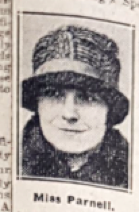
#WomensWednesday nº7 – 1 April 2026: Nancy Stewart Parnell (1901-1975) — Catholic Feminist, Pacifist and International Campaigner
Post by: Dr Carmen M. Mangion,
Birkbeck College University of London
Nancy Stewart Parnell was born in Chelsea, London on 14 May1901. The eldest child of playwright Bertram Damer Parnell and Madeleine (née Bryne) Parnell, she was a compelling feminist voice in early twentieth-century Britain whose life’s work – shaped by Catholicism, feminism and pacifism – informed her public activism and commitment.
Early life and education
Parnell was educated at Notre Dame High School in Bellerive then graduated from Liverpool University in 1922. As a university student, she was Secretary of the Student Union (1921-2) already demonstrating the political activism and public service that would characterise her later life.
Upon graduating, Parnell taught English at Liverpool’s Bellerive convent school, run by the Faithful Companions of Jesus. In 1932 she became warden at St Gabriel’s, the Catholic Hall of Residence at the University of Manchester. From 1936 to 1960 she worked for the London Regional Federation of the League of Nations Union.
Catholic feminism
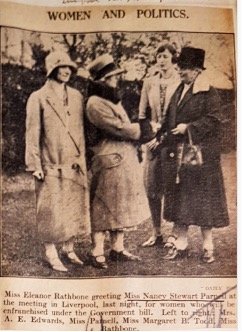
Parnell’s feminism began at home. The Parnells, mother and daughter, were early members of the influential Catholic Women’s Suffrage Society (later St Joan’s Social and Political Alliance) founded in 1911, a politically-driven Catholic feminist organisation of over 1,000 members which, by 1954, having expanded to twenty-four countries across five continents, renamed itself St Joan’s International Alliance1
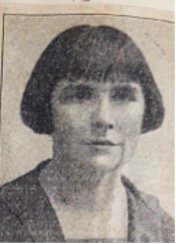
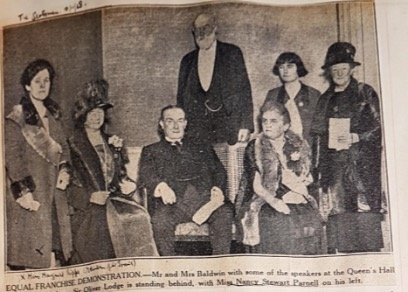
At 27, the bobbed-haired Liverpudlian looking every inch a ‘modern woman’, stepped onto the stage at Queen’s Hall in Westminster and spoke passionately to a crowd of over 2,000 women from 140 women’s organisations on the urgency of extending the vote to women on the same terms as men2. In the audience was Conservative Prime Minister Stanley Baldwin who was as captivated by her passion as was the national, local and religious press. Much was made of her modern looks and her persuasive rhetoric. The vast audience, was ‘breathless with excitement’ as Parnell
with beautiful black, bobbed, wavy hair, a clear-cut profile and an engaging voice … introduced point after point in favour of her argument. These she drove home with a quiet vigour, which caused conviction in every line. The applause was thunderous and continuous.3
The Catholic press joined the national and local press in singing her praises describing her as a ‘young and brightly shining light in the feminist movement, and deservedly something of an idol to her fellow-Catholics of the women’s feminist campaign’. 4 Parnell was adept and succinct at explaining her feminist ideals. As a member of St Joan’s Social and Political Alliance she saw equality feminism, not simply as a secular imperative, but as a religious ‘moral principle’.
Championing female educators
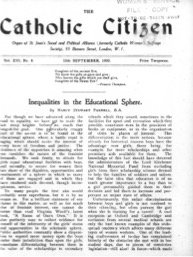
Active as well in the National Union of Women Teachers, she became its President in 1936. Her writing and speeches challenged gendered inequalities. She spoke of the inequalities in the ‘Educational Sphere’ amongst girls and boys articulating her dismay at the relative lack of scholarships for girls. The ’actual storm centre’ she argued in 1930 was unequal pay:
‘All women teachers suffer from the common injustice of unequal pay – an injustice the more difficult to bear since it has been proved that an extraordinarily high number of women teachers have dependents and a very low number of men teachers have families. In addition, secondary school mistress can point to their higher qualifications, for they have been trained in far greater numbers than their male counterparts. In co-educational secondary schools the women teachers suffer from a twofold disadvantage. First they are only considered suitable for responsible seniors posts in a very few subjects, regardless of their qualifications, and secondarily they very rarely rise to the headships of such schools.’ 5
She remained hopeful for change, noting the appointment of a woman as General Inspector by the Scottish Education Department and another as deputy Chief Inspector by the Manchester Education Authority.6
Peace-maker
Throughout her life Parnell was an advocate for peace.
As a student she was active in the Liverpool branch of the League of Nations Union (LNU) as its Honorary Secretary and later remained involved in the work of the LNU in Liverpool. The LNU was formed in 1918 to promote the efforts of the League of Nations among politicians and a wider public. It sought to encourage global citizenship through friendship and to encourage freedom from war. It was one of the most popular voluntary associations during the interwar years devoted to peace with a membership of 406,868 in 1931. 7
In line with the LNA’s promotion of peace through education, especially to schoolchildren, 8 Parnell brought her passion for peace into her classrooms speaking about the League of Nations to students and taking students9 to hear preacher and peace campaigner Maude Royden speak on disarmament.10 In 1934 she wrote Education for Peace published and distributed by the National Union for Women Teachers. She often addressed teachers, and in 1947 spoke on ‘The Teacher as Citizen of the World’ emphasising educators’ role in fostering world citizenship amongst their students. 11
Parnell encouraged her fellow Catholics to promote peace, urging participation in the 1922 No More War Demonstration held in Liverpool inviting Catholics to march behind the banner of the Catholic Women’s Suffrage Society. 12 A popular speaker, she addressed the Catholic Women’s League in Birmingham in 1928 on ‘Catholic Women and Peace’. 13
Later in 1928 she was asked by the Daily News to write on ‘If I Were Prime Minister’. Her first ambition was the ‘creation of a genuine world peace’ listing reducing Britain’s armaments expenditure and organising a world disarmament conference in London as some of the means of doing this. 14
From 1936 to 1960 she was working for the London Regional Federation of the League of Nations speaking of peace and disarmament across the country. Her international outlook and commitment to peace also led her to work closely with the Women’s International League for Peace and Freedom.15
She was a popular speaker on equality feminism, education and peace and her name frequently appeared in the national and international press as a speaker at local and national events. A prodigious writer, she published articles in the journals and magazines of the organisations she served including: The Catholic Citizen, The Woman Teacher and Headway: The journal of the League of Nations Union.
Nancy Stewart Parnell was a committed Catholic feminist, educator, and peace activist whose work quietly shaped the organisations and movements she supported. She died in 1975.
Keywords: Catholic feminism; Catholic networks; laywomen; women’s leadership; peace activism
Publications:
Parnell, Nancy Stewart, Education for Peace (National Union for Women Teachers, 1934)
Parnell, Nancy Stewart, A Venture in Faith. A History of St. Joan’s Social and Political Alliance, Formerly the Catholic Women’s Suffrage Society, 1911–1961 (St Joan’s Alliance, 1961)
Sources
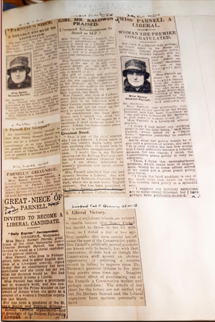
Her personal papers have not been located but material about Nancy Stewart Parnell survives in the organisations she served. The archives of the Women’s Library, London School of Economics (LSE) and Political Science holds the Records of the St Joan’s International Alliance (2SJA) and the League of Nations Union (LNU). The voluminous pressbooks kept by St Joan’s International Alliance are particularly useful as many clipping, especially from 1926, feature Parnell.
Further reading:
For more on Nancy Stewart Parnell and St Joan’s International Alliance see
Mangion, Carmen M., ‘Faith, Feminism and Politics: The Inter-War Campaigning Strategies of St Joan’s Social and Political Alliance’, Modern British History, 35.4 (2024), pp. 397–413.
Mangion, Carmen M., ‘“In the Interests of Justice, Morality and Religion”: St Joan’s Social and Political Alliance, 1911-1961’, in Twentieth-Century Lay Catholic Action and Spirituality in Britain, ed. by Jonathan Bush and Maria Power (Boydell & Brewer, 2025).
Mangion, Carmen M., ‘Nancy Stewart Parnell’, A History of Women in the British
Churches: A Biographical Dictionary, 1890-1960 edited by Andrew Chandler and Sarah Edwards (Bloomsbury, forthcoming).
(1) Women’s Library, London School of Economics and Political Science, Records of the St Joan’s International Alliance (henceforth 2SJA) 2SJA/D1/2, Undated invoice from Samuel Walker indicated the print run for the September 1939 issue of the eight-page The Catholic Citizen was 1,000 copies.
(2) 2SJA/L/09 1928 pressbook, p. xx: “Equal Suffrage”, The Times, 9 March 1928, p. 16; ‘Miss Nancy Stewart Parnell’, Yorkshire Post, 20 June 1928. The Representation of the People Act (1918) enfranchised 5 million men and 8.5 million women over 30. The 1928 Act enfranchised another 5.3 million women (3.3 million voters between the ages of 21 to 29 and another 2 million over 30 who did not meet the requirements of the 1918 Act). Martin Pugh, Women and the Women’s Movement in Britain, 1914-1959 (Macmillan, 1991), p. 151.
(3)
(4) 2SJA/L/09 1928 pressbook, p. 4, The Tablet, 17 March 1928.
(5) Nancy Stewart Parnell, ‘Inequalities in the Educational Sphere’, Catholic Citizen, 1930, p. 66.
(6) Nancy Stewart Parnell, ‘Inequalities in the Educational Sphere’, Catholic Citizen, 1930, p. 66.
(7) Susannah Wright, ‘Creating Liberal-Internationalist World Citizens: League of Nations Union Junior Branches in English Secondary Schools, 1919–1939’, Paedagogica Historica, 56.3 (2020), pp. 321–40 (p. 323).
(8) Wright, ‘Creating Liberal-Internationalist World Citizens’, p. 323.
(9) Nancy Stewart Parnell, ‘The Flapper Deserves her Vote’, The Daily Express (5 September 1928), 1928 p. 30.
(10) 2SJA/L/09 1934 pressbook, p. 4, Nancy Stewart Parnell, BA, ‘What disarmament means to the average mother’, Birmingham Post (4 July 1934).
(11) ‘A Child of today in the World of tomorrow’, The Woman Teacher (28 November 1947), p. 30.
(12) 2SJA/L/09 1922-1923 pressbook, p. 4, ‘No More War Demonstration’, Catholic Times (July 1922).
(13) 2SJA/L/09 1928 pressbook, p. x, ‘C.W.L. Activities’, E.T., 15 June 1928.
(14) 2SJA/L/09 1928 pressbook, p. x, Nancy Stewart Parnell, ‘If I were Prime Minister’, Daily News (1928)
(15) Nancy Stewart Parnell, ‘Catholic Candidatures’, The Tablet (23 November 1935), p. xx. Letter to the Editor.