
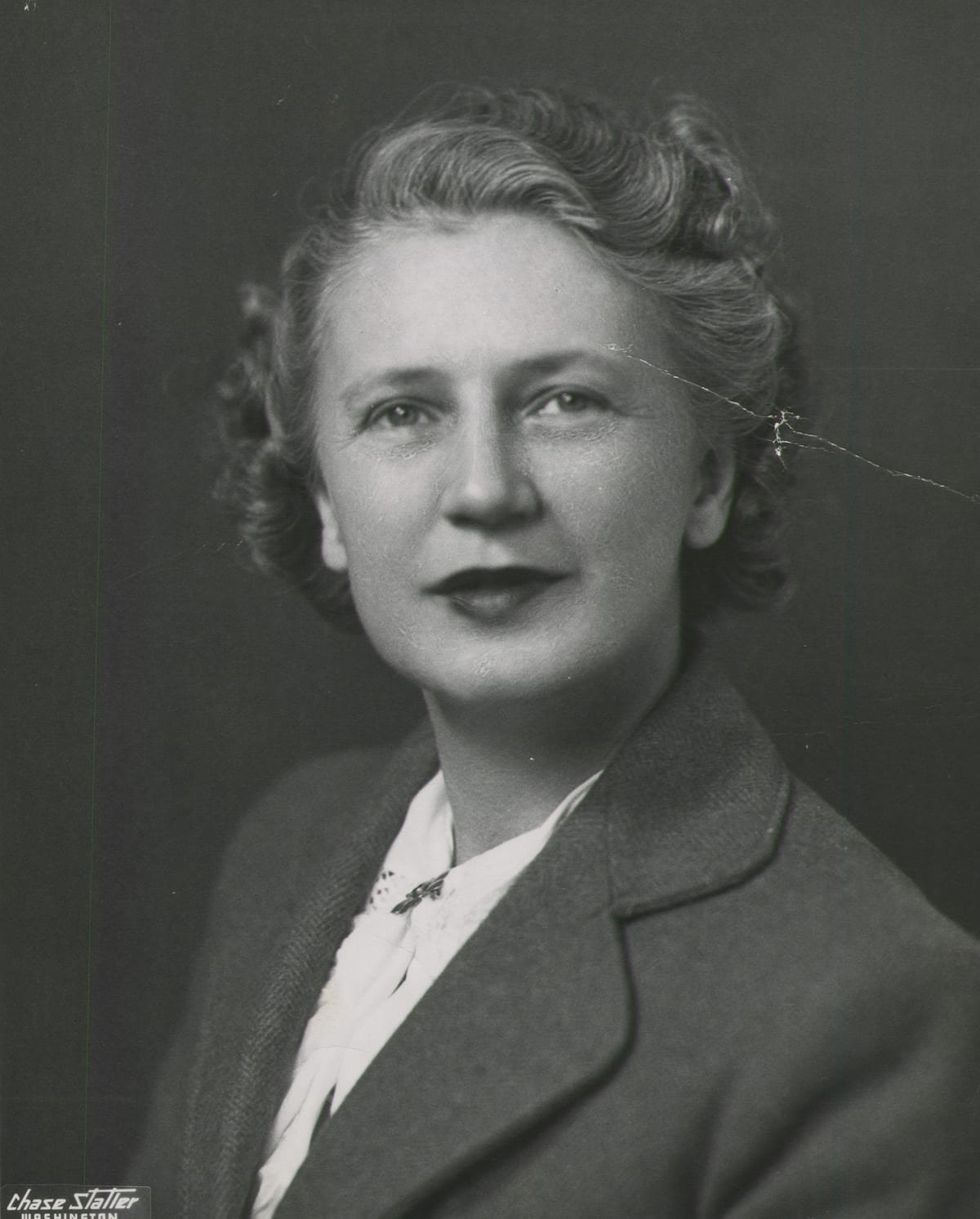
#WomensWednesday nº 9 – 9 September 2026 -Catherine Schaefer (1907-1995) at the Service of the Global Church
By Patrick J. Hayes, Ph.D., Redemptorist Archives, Philadelphia
It is a truism that information is power. When one is the gatekeeper of information, one assumes a greater degree of responsibility, of access, and of importance. This certainly attaches to the life and work of Catherine Schaefer, a mediator and shaper of sensitive information between the Catholic Church and emerging global entities seeking the welfare and security of the human family.1
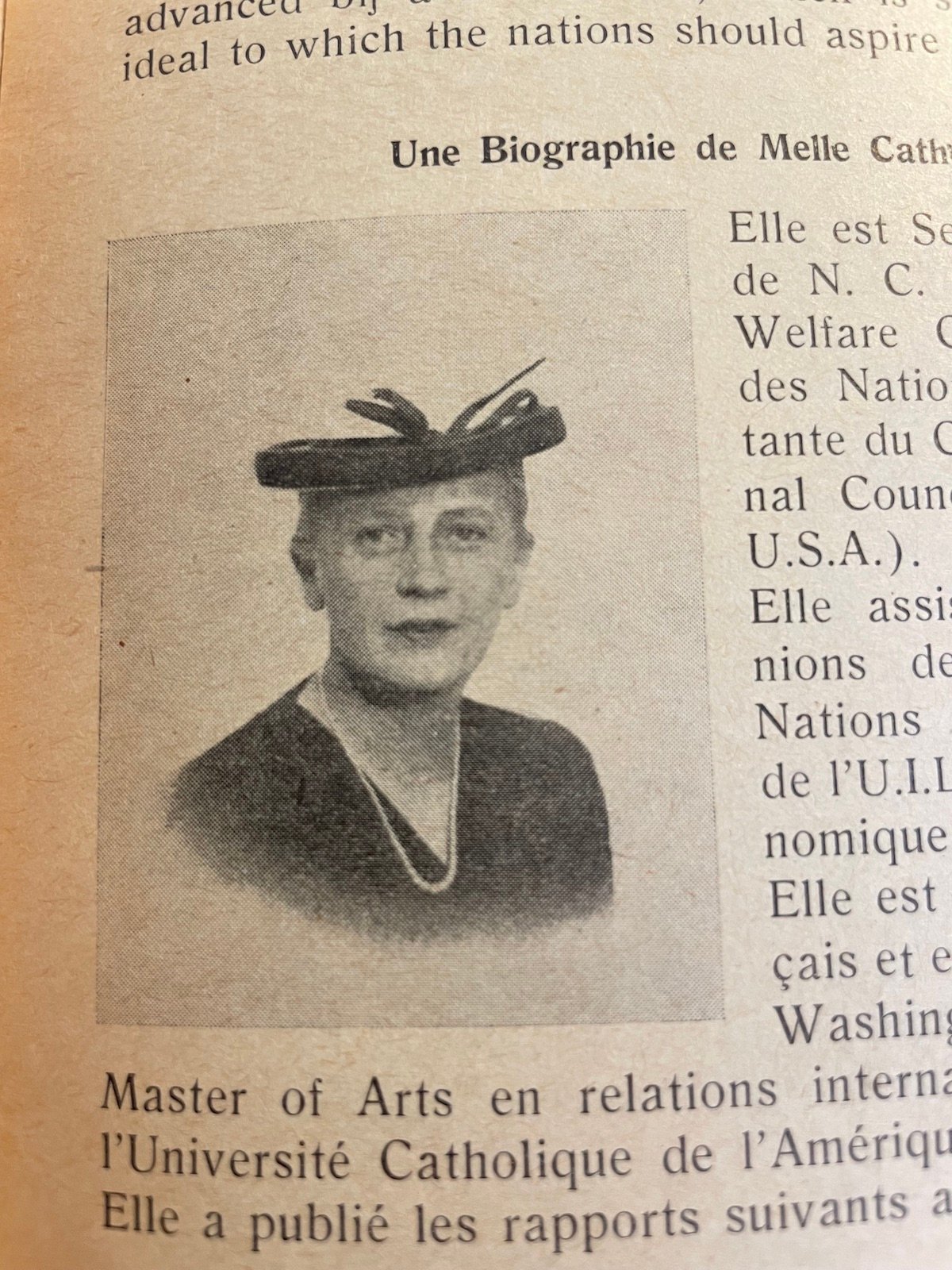
“Cahiers” de l’Union Internationale des Ligues Feminines Catholiques,
Dec. 1948, p. 17
Born June 8, 1907, in Ocean City, Maryland, Catherine Schaefer was the daughter of Anna and Joseph Schaefer and sibling to eleven others. She attended Trinity College in Washington, from which she earned her baccalaureate degree in 1927. She then went to the Catholic University of America for a master’s degree in international affairs and economics. Upon her graduation, Schaefer began a long association with the National Catholic Welfare Conference, the precursor to today’s United States Conference of Catholic Bishops. She began her tenure first as the secretary to the director of the Conference’s Social Action Department, Monsignor John A. Ryan, the formidable advocate for the Church’s social teaching. Her talents for organization were noticed and her duties within the Social Action Department increased. This included serving as de facto liaison with adjunct agencies, which allowed her to develop a broad network that would serve her well in the post-war years. She also wrote pamphlets and news releases, spoke at conferences around the United States, and served as a conduit for information in rapidly changing circumstances.
During the war itself, for instance, she was engaged as assistant executive secretary of the Catholic Association for International Peace (co-founded by Ryan in 1926) whose membership included the Jesuits John Courtney Murray and Wilfrid Parsons, as well as the Rev. Professors Fulton J. Sheen and John Tracy Ellis of the Catholic University of America. The CAIP was also stocked with men and women who had technical, diplomatic, and ethical expertise—all of whom were using their professional labors in a shared quest for peace. At CAIP she worked closely with Thomas H. Mahony, a Boston-based lawyer, professor of international law, and vice-president and president of the CAIP between 1944 and 1963. 2 While Mahony’s particular contribution came through the CAIP’s Committee on World Order, Schaefer’s role as chair of the Committee on Social Questions put her into contact with long-time associate Alba Zizzamia, who chaired the Committee on Cultural Relations. 3 It was in this joint capacity of serving both the CAIP and NCWC that, in September 1946, Schaefer took on a new position as the principal consultant and liaison for the NCWC’s Office for United Nations Affairs based at the UN in New York. 4 With her compatriot Zizzamia, she practically single-handedly launched and ran the office until it closed in 1971.
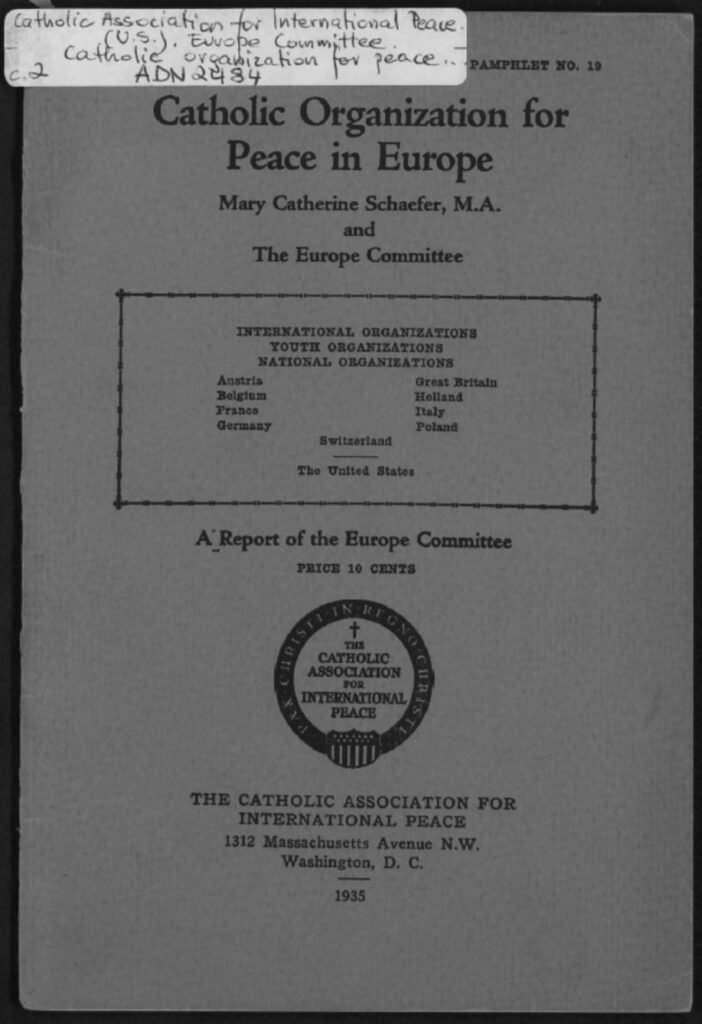
University of Notre Dame Archives, available online through CurateND
Post-war reconstruction was a priority for American bishops and Schaefer leant her expertise on a number of fronts. On purely functional lines, however, she was to serve as an institutional sounding board either for agencies connected to the United Nations directly or for those who had an interest in its development. Her connection to the UN began when it was still in gestation, having attended the UN Conference on International Organization in San Francisco in April 1945. The results of her intelligence gathering were often brought out through various speaking engagements. For instance, the National Council of Catholic Women (NCCW) heard Schaefer’s report on the recent UN Conference on International Organization in San Francisco, a gathering that led to the UN’s establishment in New York.5
When the UN finally did arrive in New York to begin its deliberative work, Schaefer’s role deepened, partly through affiliations with the bishops’ conference, the NCCW, and by extension, the International Union of Catholic Women’s Leagues (IUCWL), which became, after 1952, the World Union of Catholic Women’s Organizations (WUCWO). The IUCWL was one of the first two International Catholic organizations to gain consultative status with the UN and its agencies, including the United Nations Economic and Social Council (ECOSOC, 1947), the United Nations Educational, Scientific, and Cultural Organization (UNESCO, 1948), and later the United Nations Children’s Education Fund (UNICEF, 1952) and the Food and Agriculture Organization (FAO, 1953). Far from being a marginal observer, Schaefer was embedded in the emerging architecture of global governance.
Among her initial responsibilities as head of the bishops’ office was to register the NCWC as an officially recognized NGO at the UN. She then had to marshal interest in the Church’s perspective on a universal declaration on human rights.6 The NCWC released its draft declaration in February 1947 and immediately received favorable feedback, a fact no doubt pleasing to Schaefer who had contributed significantly to the text. 7 Advocating before American representatives to the human rights commission, as well as friendly foreign leaders, she hoped that language dealing with international cooperation would cut across ideological lines. Taking her cues from Jacques Maritain’s earlier interventions on the use of natural law as a unifying construct, she sought to place before UN officials the prospect of having widely agreed-upon principles serving discussions on contentious matters, such as rights and freedoms (of religion especially, but also of the state). Another Frenchman, commission member René Cassin, warmed to Schaefer’s proposals. 8 Though Jewish, the so-called “Father of the Universal Declaration” could be found quoting the NCWC’s text nearly verbatim in his interventions on the human rights commission, especially on matters pertaining to family rights. But it was the Lebanese rapporteur for the commission, Charles Malik, who was instrumental in including the language supplied by Schaefer into the drafting of the universal declaration. It almost did not come to pass. Malik had Schaefer, Jesuit Father Robert Graham, Judge Joseph Dore of New York, and a few lawyers to dinner to discuss the matter. After reviewing the NCWC’s text, he suggested further refinement to make the text more palatable to fellow commission members. The men at the table jumped at the suggestion but left Schaefer on the side line. Writing to Monsignor Howard Carroll, the NCWC General Secretary, shortly afterward, Schaefer noted blithely, “While the old proverb about the woman scorned undoubtedly holds true, the technique and the motives for freezing me out amuse and amaze me.” 9
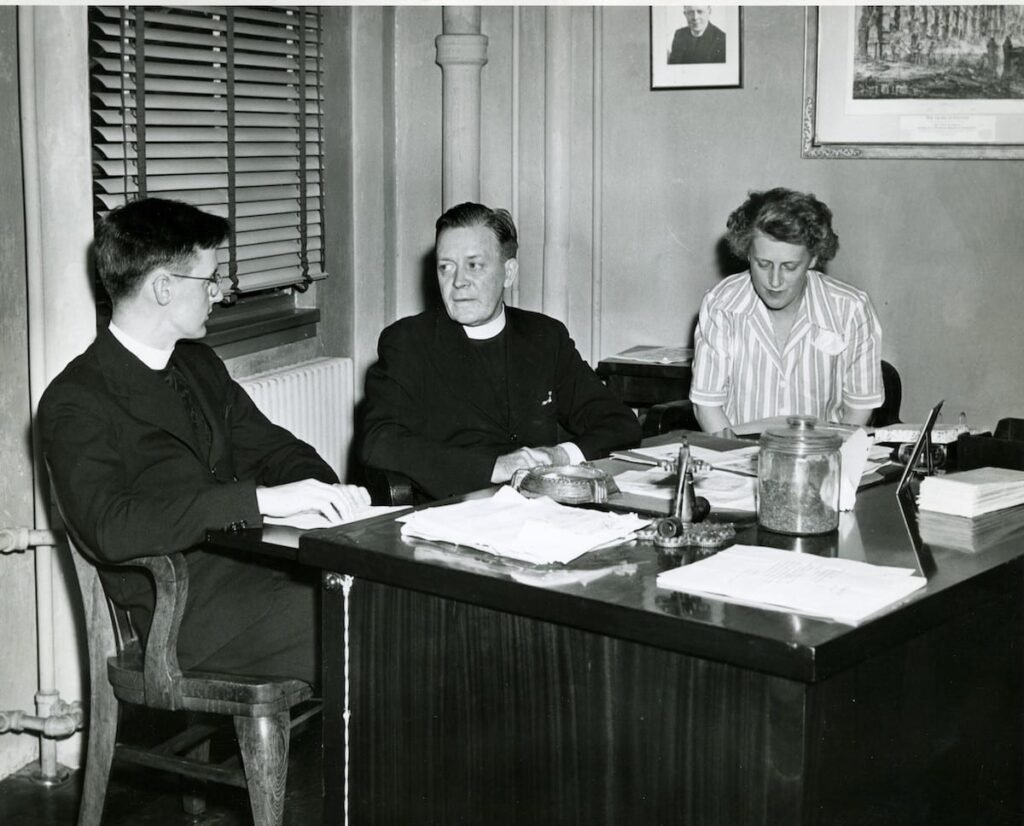
From left, Fathers George Higgins and Raymond McGowan, and Catherine Schaefer (date unknown; National Catholic Welfare Conference, Office of the General Secretary Records)
By the summer of 1948, Schaefer was the assistant to the General Secretary at the NCWC with an office in New York. Ostensibly, it was called the Office for UN Affairs, but it later morphed into a hub for information gathering and dissemination and was frequently referred to as the Catholic Information Center. Its walls, however, were not constricting. In July 1948 Schaefer headed to Germany for several weeks as part of the United States Office of Military Government for Germany as a “visiting expert in the field of women’s affairs.” She was accompanied by her NCWC colleague, Father George Higgins, of the Social Action Department. 10 At the time she was also a consultant for the International Union of Catholic Women’s Leagues at the ECOSOC. While in Europe, Schaefer was scheduled to attend the UN General Assembly in Paris. Her travels added to her international profile and helped place a Catholic voice in key meetings. All of this served her well at the UN. 11 Her travels added to her international profile and helped place a Catholic voice in key meetings. All of this served her well at the UN.
The work of connection was constant. Intense lobbying was done in relaxed, social settings. Almost always the challenge came from communistic or theocratic countries. Schaefer’s familiarity with the plight of women—on human rights generally, but also on birth control and the rights of parents to educate their children—required sustained pressure on key decision makers. 12 In the 1950s, Schaefer expanded the office to include two others—Jean Gartlan, a researcher, and Jeanne Miller, the office coordinator and secretary. 13 Gartlan would later chronicle the history of the Office for UN Affairs and Schaefer’s importance on the world stage. 14
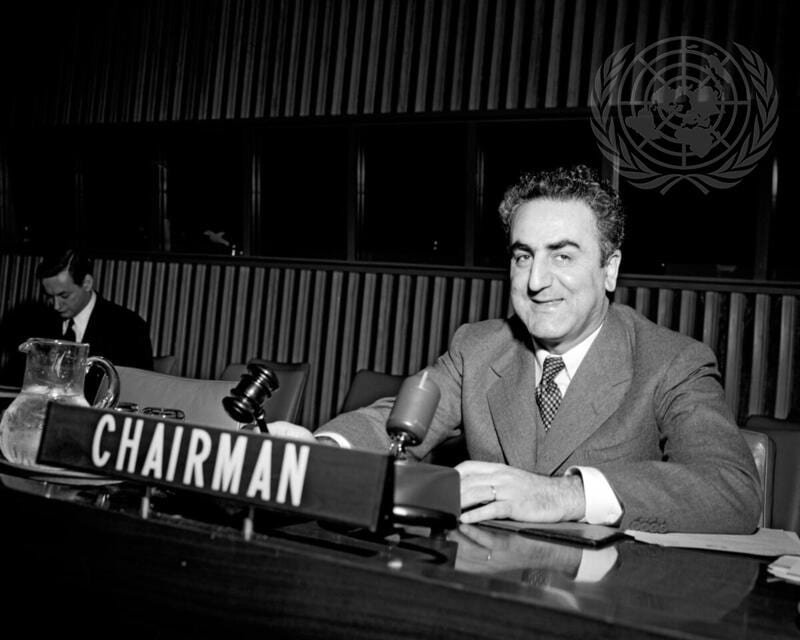
Charles Malik, UN Rapporteur and Chair of the Commission on Human Rights (UN photo, 1952)
https://media.un.org/photo/en/asset/oun7/oun7713501
If in its first decade of operations, Schaefer and her staff were concerned with the development of relationships and coordinating Catholic groups at the UN, the next decade was about sustaining the good will in the midst of a cold war atmosphere. On account of her close and integral work with the NCWC, the NCCW, and International Union of Catholic Women’s Leagues (IUCWL), Schaefer poured her energy into the UN’s Commission on the Status of Women, which first met at Lake Success, New York, in February 1947. Her major contribution to this commission came in May 1948, when she represented the IUCWL at a summit meeting of some 200 international NGOs in Geneva. Not only did she help prepare the agenda, but she also personally put human rights on the docket as a discussion theme. 15 In later reports to the NCWC, she spoke about her office’s proposal for legal safeguards for monogamous marriages in territories dominated by polygamy, the protection of young girls and suppression of trafficking and exploitation of prostitutes, the gaining of voting rights for women in all countries, as well as a continued fight for equal access to education for women.16
As Jesuit Joseph Rossi has indicated, by 1960 the Office of UN Affairs was becoming more of an internationalized body, even though the NCWC continued to fund it. International Catholic Organizations (ICOs) gravitated to its headquarters on East 47th Street. When Schaefer and Zizzamia attended international gatherings, particularly those connected to the Commission on the Status of Women, the ICO community often compared notes with them, prepared their own position papers, or devised strategies for collaboration and policy recommendations. For a 1960 Commission meeting in Buenos Aires, for example, Schaefer made several interventions on behalf of the WUCWO based on information gleaned from over 90 local affiliates across the globe.
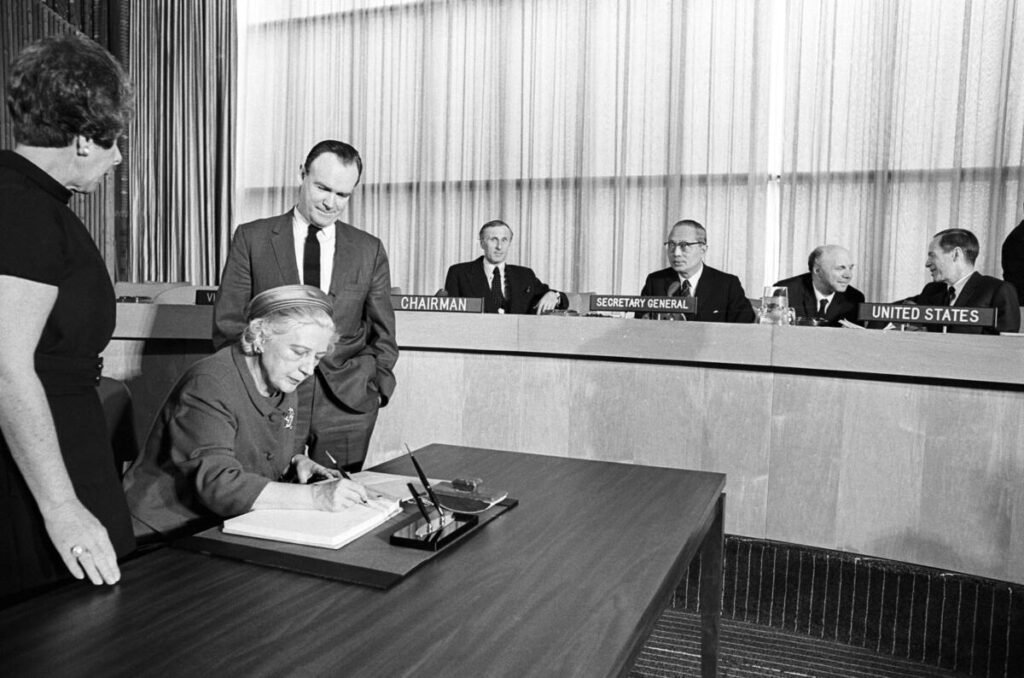
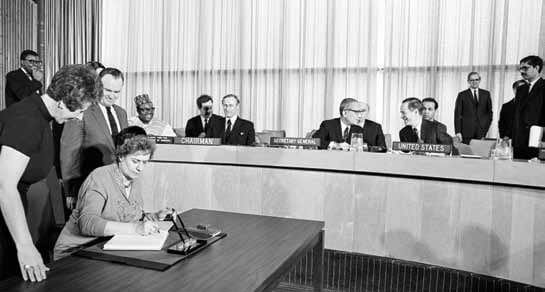
Catherine Schaefer and Alba Zizzamia representing the WUCWO and the National Conference of Catholic Bishops sign a register for public contributions discussing apartheid and racism in South Africa, March 21, 1969. UN photo/Yutaka Nagata
During the period of the 1960s, resolutions before the Commission and other UN bodies dealing with human rights, economic and social standing of women, and the protection of children almost always had the Office of UN Affairs’ fingerprints on them. Schaefer gave special attention to how these matters were playing out in the developing world. But while her eyes were fixed on the women she met and represented from distant corners of the Earth, she perhaps lost sight of her immediate sponsors. The American bishops were struggling financially and by 1965, the writing was on the wall. Schaefer’s office, for all the good it did, could not be sustained. After the Second Vatican Council the American bishops altered their conference structure. The NCWC ceded its presence at the United Nations to the Permanent Observer Mission of the Holy See. This began a multi-year wind down of the Office of UN Affairs. In June 1972 Schaefer’s office officially closed and Schaefer went into retirement. 17
Though she rarely sought the limelight, a profile of Schaefer was released to the Catholic press in January 1950. It described her as “blonde, affable, soft-spoken” but also “chatty, responsive and charming.” Her demeanor notwithstanding, she rattled the world order by making room for her Church and bettered humanity for it. Shaeffer died at the age of 88, November 25, 1995, and is buried in the St. John the Evangelist cemetery in Forest Glen, Maryland.
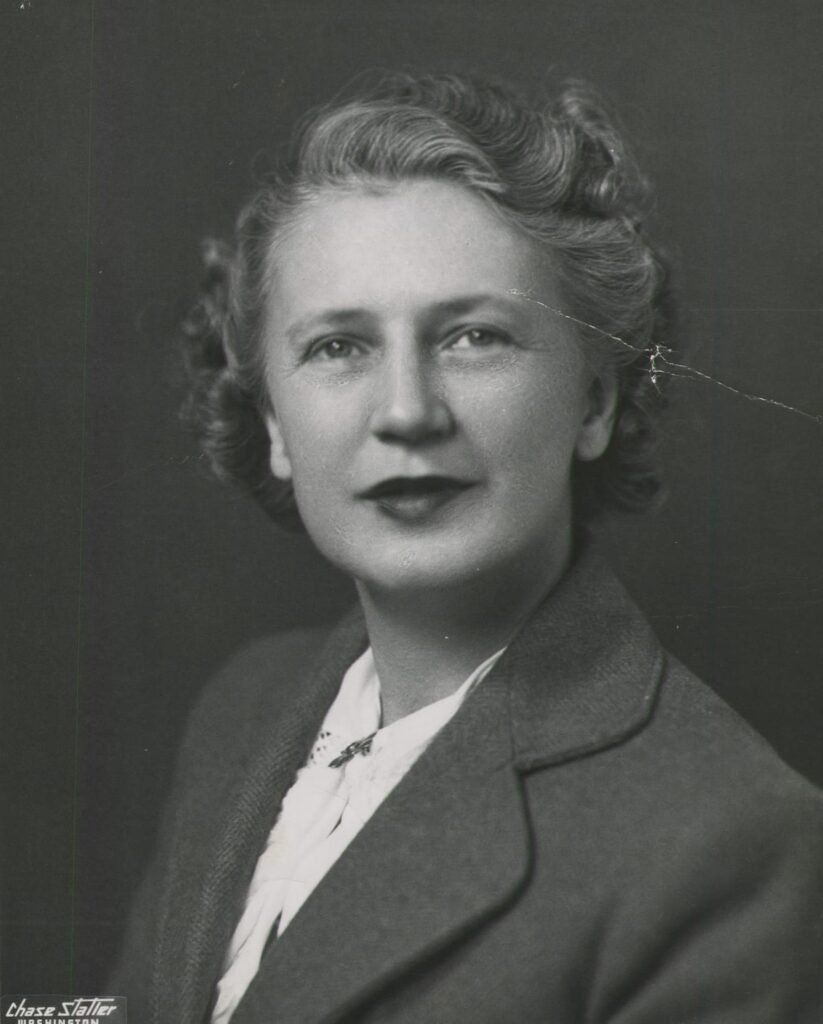
Catherine Schaefer (Marquette University Archives, Catholic Association for International Peace, nd)
Author bio: Patrick J. Hayes, Ph.D., is the archivist for the Redemptorists in the United States, a position he has held since 2008. With a doctorate in religious studies from the Catholic University of America (2004), he taught at the undergraduate level in colleges both in the United States and Sierra Leone. He’s the author or editor of six books, including A Catholic Brain Trust, A History of the Catholic Commission on Intellectual and Cultural Affairs (2011).
*Synergies with TheoFem’s upcoming publications:
- Núñez Bargueño, Natalia. “Renewing the Face of The Earth”: Catholic Laywomen and Vatican Engagement in the Making of the Early United Nations, 1945–1952”, European Review of History (forthcoming, September 2026).
- Núñez Bargueño, Natalia. “Observers before the “Observer”: the pioneer work of Catholic Laywomen in the United Nations (1945-1965)” in Natalia Núñez Bargueño, Alana Harris and Anna Nasser Beyond Secular Internationalism: Gender, Religion, and International Organizations, 1919-1989, Leuven University Press/Kadoc currently under preparation.
1 There is no full-scale biography of Schaefer, but see Joseph S. Rossi, American Catholics and the Formation of the United Nations (Lanham, MD: University Press of America, 1993); idem., “Catherine Schaefer and the Strategy for a Catholic Presence at the United Nations, 1946-1947,” Records of the American Catholic Historical Society of Philadelphia, vol. 108, no. 3-4 (Fall/Winter 1997-1998): 53-72; idem., Uncharted Territory: The American Catholic Church at the United Nations, 1946-1972 (Washington, DC: Catholic University of America Press, 2006); and idem., “‘The Status of Women’: Two American Catholic Women at the UN, 1947-1972,” Catholic Historical Review, vol. 93, no. 2 (April 2007): 300-324.
2 Mahony’s obituary: “Thomas H. Mahony, Lawyer in Boston,” The New York Times (July 22, 1969): 39.
3 Zizzamia would figure in the development of the Office of UN Affairs while serving as Schaefer’s assistant. Born in Hartford, Connecticut, she was a public school teacher but when she joined Schaefer she was a professor of Italian literature at Trinity College in Washington.
4 “Holds NCWC Posts Twenty-Five Years,” The Catholic Bulletin, vol. 43, no. 9 (February 28,1953): 2.
5 “Hear Report from UNCIO,” The Catholic Bulletin, vol. 35, no. 27 (July 7, 1945): 4.
6 For a general history of the Declaration, see Johannes Morsink, The Universal Declaration on Human Rights: Origins, Drafting, and Intent (Philadelphia: University of Pennsylvania Press, 1999). For additional information on the Catholic contributions to the development of the Declaration, see Philippe de la Chappelle, La Déclaration Universelle des Droits de l’Homme et le Catholicisme (Paris: Librarie Générale de Droit et de Jurisprudence, 1967).
7 See Rossi, Uncharted Territory, p. 89.
8 For a brief but informative profile of Cassin, see https://www.humanrightscentre.org/blog/rene-cassin-father-universal-declaration-human-rights.
9 Schaefer to Carroll, June 15, 1947, in Archives of the Catholic University of America, NCWC, Box 52: International Affairs, UN Human Rights, 1946-1947, Folder 14 and cited in Patrick J. Hayes, A Catholic Brain Trust: The History of the Catholic Commission on Intellectual and Cultural Affairs (Notre Dame University Press, 2011), 95.
10 In addition to the physical copies held by the Archives of the Catholic University of America, NCWC/USCCB, General Secretary files, the annual reports for the National Catholic Welfare Conference departments are available online at https://www.thecatholicnewsarchive.org.
11 “NCWC Aide Germany Bound For Several Weeks,” Catholic Standard and Times, vol. 53: no. 43 (July 30, 1948): 8.
12 For instance, see “UN Birth Control Study Criticized,” The Catholic Bulletin (Minneapolis), vol. 43, no. 6 (February 7, 1953): 1.
13 See “’Jubilee’ Lauds NCWC United Nations Bureau,” The St. Louis Review, vol. 15, no. 11 (March 11, 1955): 10.
14 See further Jean Gartlan, At the United Nations: The Story of the NCWC/USCC Office for United Nations Affairs 1946-1972 (Baltimore: Gateway Press, 1998).
15 See Rossi, “‘The Status of Women,’” 303.
16 For details on these interventions, see Rossi, ibid., 305-310.
17 See Rossi, ibid., 323
18 See the “Spotlight” write up on Schaefer of January 24, 1950, Archives of the Catholic University of America, referenced in an email communication with the author 2 July 2026.