
#WomensWednesday nº8 – 24 June 2026: International Day of Women in Diplomacy
Rethinking the History of Diplomacy through the Lenses of Gender and Religion
On the occasion of the International Day of Women in Diplomacy (24 June), TheoFem is pleased to share two public-facing articles to contribute to public debate and to promote a more inclusive understanding of international history. These outreach publications form part of the project’s commitment to disseminating research beyond academia and to encouraging reflection on the historical role of women in global governance.
Article nº 1
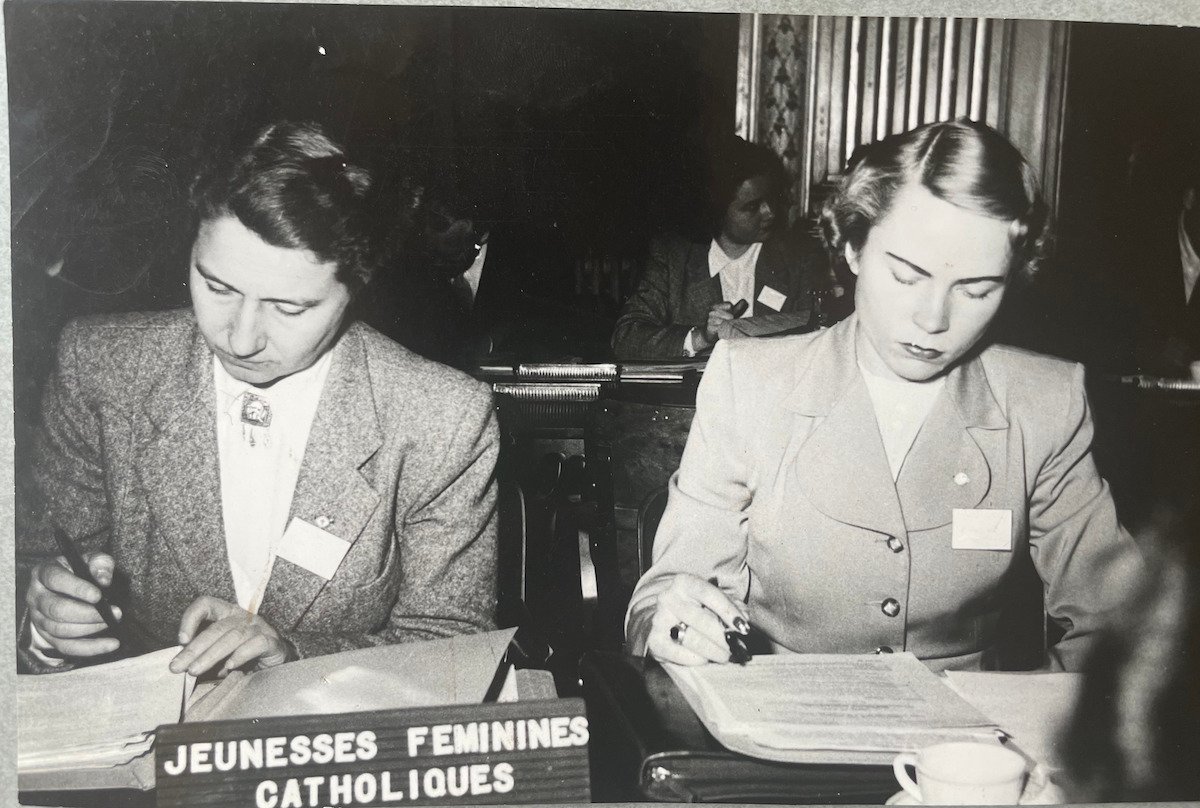
Published in The Conversation,“Where do women feature in the history of diplomacy?” invites readers to reconsider what diplomacy is and who is recognised as a diplomatic actor. Rather than viewing diplomacy solely through the actions of states, ambassadors, and foreign ministries, the article argues for a broader understanding that includes NGOs, international organisations, transnational advocacy networks, and religious actors.
Drawing on findings from the TheoFem project, the article demonstrates how Catholic laywomen participated in international affairs long before women gained significant access to official diplomatic careers. Through organisations such as the World Union of Catholic Women’s Organisations (WUCWO), they acted as delegates, experts, observers, intermediaries, and advocates within the emerging structures of the United Nations and other international institutions after 1945. Their work contributed to debates on social welfare, education, development, peace, and women’s rights.
The article also highlights the importance of bringing religion back into the history of international relations. Women of faith have often occupied a double blind spot: overlooked in secular histories of diplomacy and marginalised within traditional religious narratives. By combining perspectives from gender history, religious studies, and diplomatic history, the article shows how faith-based women developed innovative forms of international engagement and exercised influence in ways that challenge conventional definitions of diplomacy.
Read the article:
https://theconversation.com/where-do-women-feature-in-the-history-of-diplomacy-282742
Article nº 2
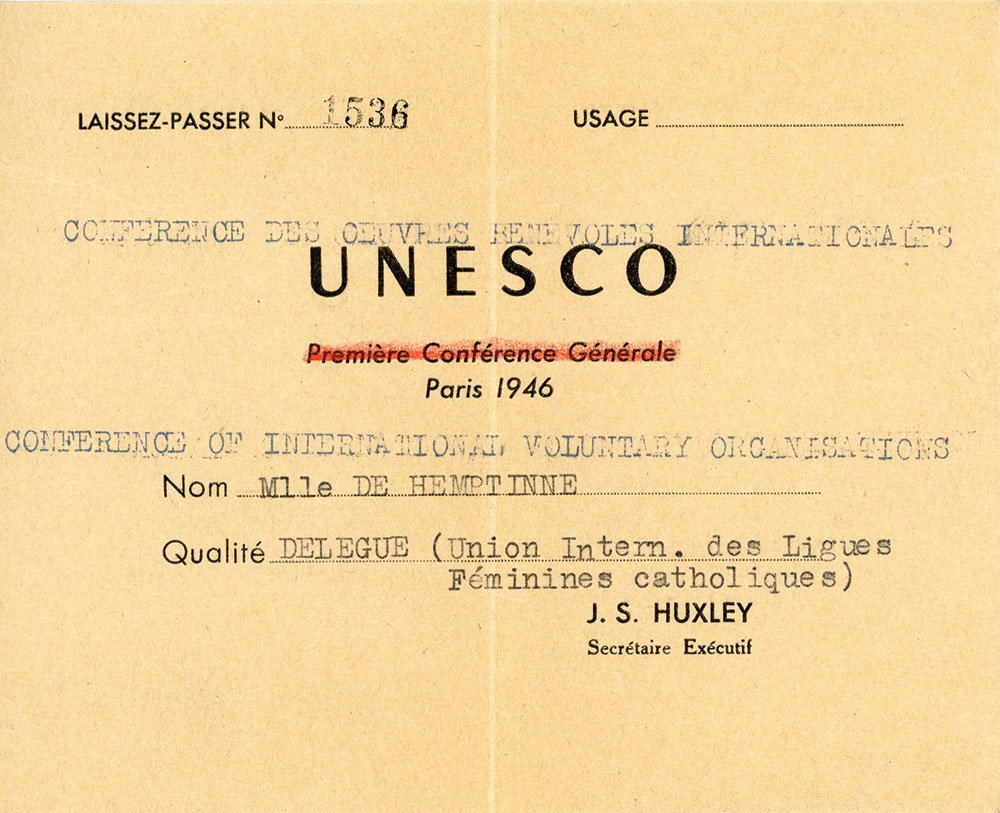
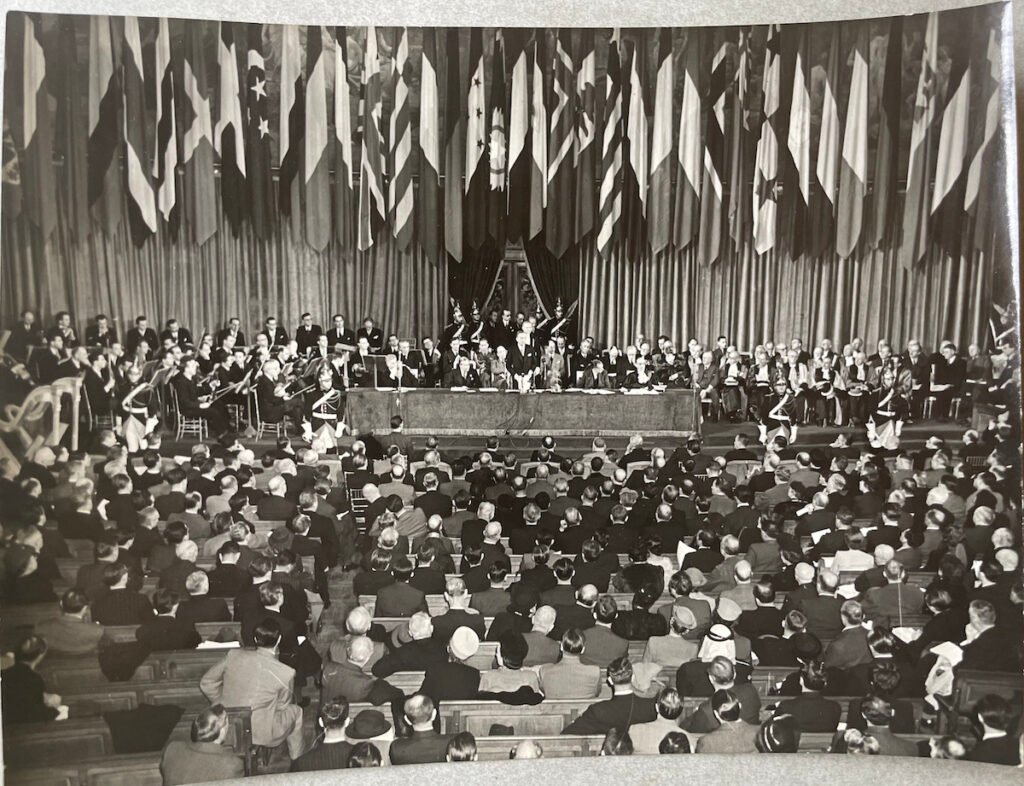
Entitled “A Passport to the World”, this article published in Dutch begins by mentioning a seemingly modest archival document: an access pass to attend the first General Conference of UNESCO in Paris in 1946. This pass belonged to laywoman Christine de Hemptinne (see #WomensWednesday post nº5). Far from being a simple administrative paper, this document opens a window onto a largely forgotten dimension of twentieth-century history: the participation of Catholic women in the consolidation of international institutions after the Second World War.
The article examines how women such as Catherine Schaefer, Jadwiga de Romer, Françoise de Saint-Maurice, Pia Colini-Lombardi and de Hemptinne represented Catholic organisations within the emerging structures of the United Nations system. Through organisations such as the World Union of Catholic Women’s Organisations and the International Catholic Social Service Union these women became active participants in discussions on human rights, women’s rights, equal pay, refugee protection, religious freedom, family policy, and international solidarity.
Rather than presenting women merely as auxiliary figures, the article highlights their role as experts and international actors who navigated complex relationships with both ecclesiastical authorities and secular organisations. Their experiences reveal that diplomacy extended far beyond embassies and state institutions and that religious women played a significant role in shaping international debates in the early post-war world.
More broadly, the article argues that historical narratives of diplomacy remain incomplete if they focus exclusively on statesmen, diplomats, political elites and secular actors. By placing women and religion at the centre of the analysis, it invites readers to rethink how international politics has been practised, who has participated in it, and which actors have been remembered—or forgotten—in historical accounts. The story of a simple UNESCO pass thus becomes an invitation to reconsider the history of diplomacy itself.
Read the original Dutch article:
https://kadoc.kuleuven.be/koorts/artikels/2026/26_01_04
(For the English version of the articles see below)
At its heart, these two contributions are not only about recovering forgotten historical actors. They are also about rethinking diplomacy itself: questioning which forms of political action, expertise, representation, and leadership societies choose to recognise and remember. Such reflections remain highly relevant today as discussions on gender equality, diversity, religious pluralism, and international cooperation continue to shape public life (see #feministdiplomacy campaigns worldwide).
We hope that this article will be useful to students, educators, and the wider public, and that it will encourage further dialogue on the intersections of gender, religion, and international politics.
***English longer version of the Koorts article: “A Passport to the World”
In the archive of Christine de Hemptinne (1895–1984), a bundle of small, seemingly insignificant cards offers a glimpse into an unknown dimension of twentieth-century history: the role Catholic women played on the international diplomatic stage. Among these cards is a laissez-passer for the first General Conference of UNESCO, held in Paris in 1946.
Christine de Hemptinne, born into a noble family in Ghent, was an influential figure in the Catholic women’s movement and Catholic Action. During the UNESCO conference, she represented the International Union of Catholic Women’s Leagues. This umbrella organization of Catholic women’s associations was founded in 1910 and grew over the years into an important actor both within and beyond the Catholic Church. The laissez-passer in De Hemptinne’s name testifies to the early presence of Catholic women within the United Nations and their role in debates on postwar peacebuilding, reconstruction, education, and cultural exchange.
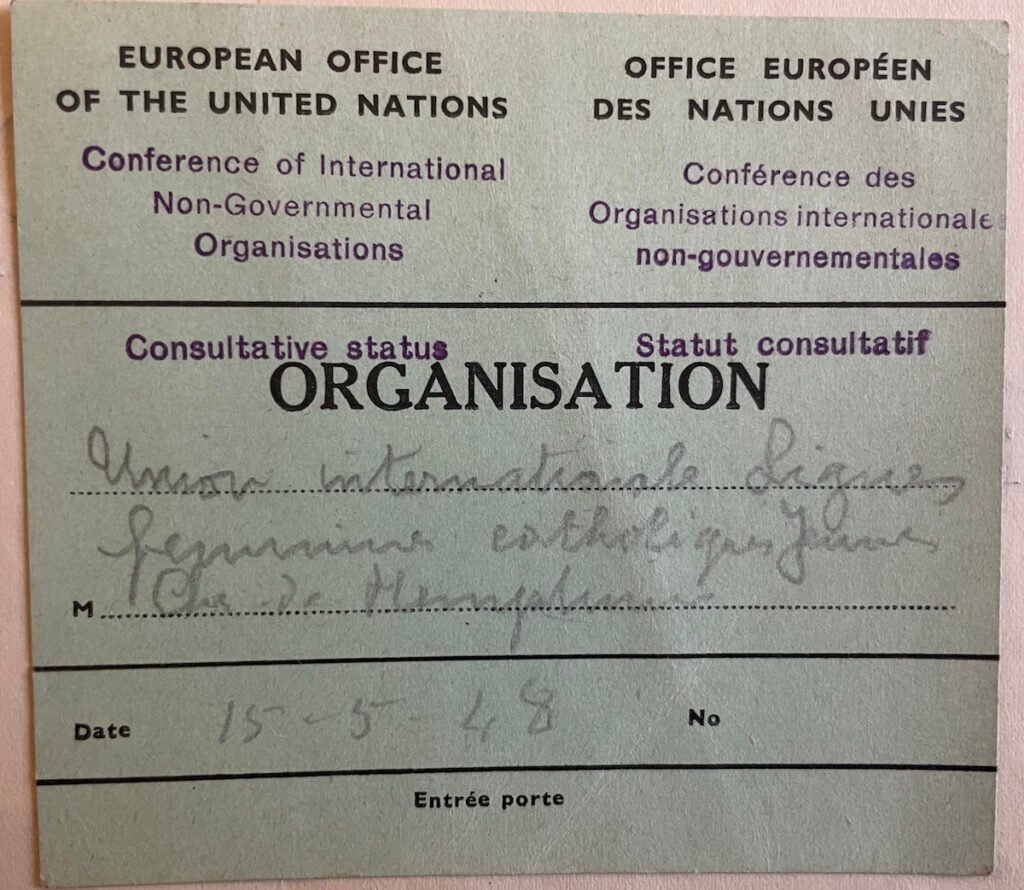
From 1947 onwards, the organization De Hemptinne represented, obtained consultative status as a Catholic NGO within United Nations bodies. By the late 1940s, only three Catholic organizations – the Union, International Union of Catholic Social Service (also led by women), and Pax Romana – as well as the mixed, or interconfessional, International Federation of Christian Trade Unions had managed to acquire such a position. Through their presence, the Catholic Church – and the Vatican in particular – was able to exert influence on emerging international structures such as the key UN Commissions on Human Rights and on the Status of Women.
Christine de Hemptinne and female colleagues from other countries, such as Catherine Schaeffer (United States), Edwige de Romer (Lithuanian-Polish), Françoise de Saint-Maurice (France), and Pia Colini-Lombardi (Italy), voiced Catholic perspectives during meetings on a wide range of issues: women’s suffrage, equal pay for equal work, the right to asylum for refugees, exiles and war victims, religious freedom, the right to life, family policy, international cooperation, and solidarity.
This unique position often brought these women into conflict with existing power structures. They sometimes clashed with church authorities when they ventured into areas that tested the limits of what was considered acceptable within Church doctrine. At the same time, tensions arose with non-Catholic organizations, which often disagreed with the Catholic-inspired views of De Hemptinne and her colleagues regarding the role of women in the family and society. Yet international contacts with women and men from other religious and secular traditions also led, at times, to unexpected collaborations in defense of shared human values. In this manner, these women contributed to creating an environment of greater lived or vernacular interreligious understanding that would flourish during the Second Vatican Council.
These cards illustrate the presence of women in international deliberations and thus nuances existing historical narratives. While historiography has largely focused on the role of church authorities and male diplomats (in theology and internationalism), it becomes clear that (lay) women were far from marginal figures on this stage. Indirectly, the card also shows that religion played a role in the early history of the United Nations – an aspect often overlooked in historical research. Religious NGOs and umbrella organizations – and the women within them – contributed to development and religious debates that shaped the postwar world. The laissez-passer of Christine de Hemptinne stands as a symbolic reminder of the role of both women and religious actors in mid-twentieth-century internationalism.
Photos:
KADOC, ARCHIEF Christinne de Hemptinne BE.942855.194.924 and BE942885.194.994.