
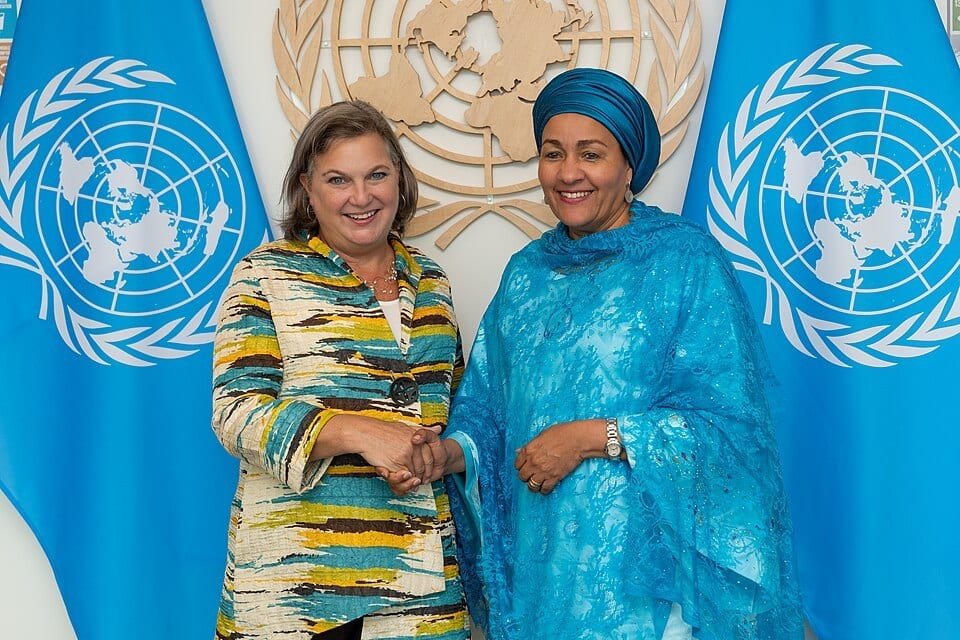
meets Acting Deputy Secretary Victoria Nuland,
on the margins of the General Assembly in 2023
(U.S. Department of State, public domain)
<- Mouse above the image to enlarge
Today, the World Union of Catholic Women’s Organisations brings together around one hundred Catholic women’s organisations from across the globe. The organisation continues to maintain representation at the United Nations and at the Council of Europe. In 2021, it initiated the World Women’s Observatory (WWO), which aims to map and improve the position of vulnerable women in society.
Yet, looking back at the history of laywomen means doing more than shedding new light on Catholic women’s roles after 1945. Their experiences ran parallel to those of women in many other religious and cultural contexts: Jewish women played active roles in postwar humanitarian initiatives, Muslim women campaigned for civil and religious rights in newly established nations, and Orthodox women found ways to exert influence within (post)communist societies. Much comparative and cross‑cultural research remains to be done to fully account for these, and sometimes entangled, histories.
For decades, religious women from different traditions have been active players on the global stage. A critical reflection on this longer history deepens our understanding of contemporary challenges, while also inviting us to consider more inclusive forms of leadership and women’s participation in today’s European, global, and multireligious world.